
Welcome to DOLE KM System
Knowledge Management Portal

Articles & Policies
Stay updated with the latest information

Trainings & Development
Empowering workers with new skills
Knowledge Management Framework of the Department of Labor and Employment XI
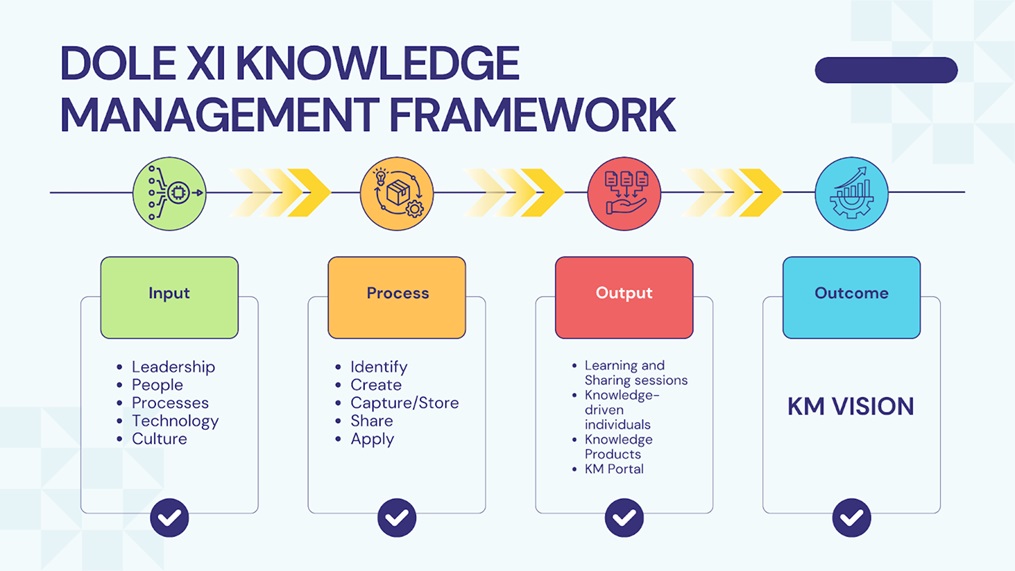
The DOLE XI Knowledge Management Framework is a structured and dynamic process of fostering an environment where the experiences, insights, and innovations of employees, stakeholders, and clients are valued and transformed into actionable knowledge that enhances labor and employment service delivery.
Inputs— Leadership, people, processes, technology, and culture—which serve as the essential enablers of KM. These inputs feed into a series of KM Processes, including the identification, creation, capture, storage, sharing, and application of knowledge. These processes, in turn, produce significant KM Outputs, such as knowledge-empowered individuals, innovative knowledge products, and accessible knowledge-sharing platforms. Together, these elements drive the organization toward the realization of its KM Vision: to become a highly competent and knowledge-driven organization that leverages knowledge as a strategic asset. This vision supports the delivery of fully automated, high-quality, and inclusive labor and employment programs and services—ultimately contributing to the mission of ensuring decent and productive employment opportunities for all Davaoeños.
1. Inputs
- Leadership — Leadership in Knowledge Management at DOLE XI is evident in its strong and consistent support for KM initiatives—demonstrated through the provision of resources, capacity-building efforts for the KM Core Team, and the promotion of innovation and continuous improvement. This leadership is further reflected in the formal establishment of structures such as the KM Committee (e.g., Office Order No. 76, s.2024) and regular leadership engagements through Management Committee (ManCom) meetings.
- People — People are central to DOLE XI’s Knowledge Management efforts, serving as key drivers of knowledge creation, sharing, and application across the organization. The establishment of a cross-functional KM Core Team—with clearly defined roles and responsibilities—ensures inclusive representation, shared accountability, and collective ownership of KM initiatives. The designation of KM Focal Persons across divisions and field offices further enhances the reach, localization, and responsiveness of KM practices. Through active documentation and assessments, personnel at all levels contribute to capturing and applying institutional knowledge.
- Processes — Knowledge Management processes at DOLE XI are guided by established operational procedures and systems that facilitate the effective capture, sharing, and use of knowledge. These include structured planning and performance review activities, client feedback mechanisms integrated into decision-making, and the use of standardized tools such as After-Action Reviews. Through these processes, the organization ensures continuous learning, performance improvement, and informed action across all levels.
- Technology — The technology at DOLE XI includes operational online systems, digital repositories, collaboration tools, and communication platforms that support knowledge creation, sharing, and storage. The use of cloud services, digitized submission processes, teleconferencing platforms, and social media enables faster and more efficient KM practices. Supported by network security measures, these technologies enhance decision-making, knowledge accessibility, and operational efficiency.
- Culture — A culture of knowledge sharing and continuous learning is aimed to be deeply embedded in DOLE XI’s organizational environment. This culture supports not only the creation and dissemination of knowledge but also the preservation of institutional memory, enabling DOLE XI to adapt, evolve, and sustain excellence in service delivery.
2. Processes
At DOLE XI, knowledge is primarily identified through a range of operational and strategic
engagements, including planning workshops,
performance assessments, after-action reviews, and program-level meetings. These structured
forums surface critical insights,
synthesize field and regional-level data, and capture lessons learned from actual
implementation. By fostering cross-unit collaboration,
these engagements allow both tacit and explicit knowledge to emerge from day-to-day practice and
collective experience.
Simultaneously, knowledge undergoes a validation process to ensure its credibility, relevance,
and alignment with organizational priorities.
This process involves peer review or formal endorsement by appropriate authorities, depending on
the nature and scope of the knowledge.
Validation may occur at the level of the immediate unit head, division chief, or member of the
management committee, ensuring that institutional
standards are met before adoption.
Once validated, knowledge is captured and codified through various documentation tools,
including technical and narrative reports, meeting minutes,
success stories, AARs, standard operating procedures (SOPs), training manuals, and IEC
(Information, Education, Communication) materials.
The knowledge products are systematically organized and preserved using both digital and
physical storage systems. Digital assets are stored in shared
repositories such as the DOLE XI Website Google Drives, and disseminated through internal
channels like email, while physical documents are archived
within the respective office units.
Knowledge is disseminated through internal and external channels to promote awareness and use.
Internally, this includes meetings, briefings, learning
and development sessions, and official issuances such as memoranda, regional orders, and
advisories. Externally, selected knowledge assets—such as reports,
advisories, and program highlights—are published on the DOLE XI website and social media
platforms, fostering transparency and stakeholder engagement.
Beyond documentation and dissemination, DOLE XI ensures that knowledge is applied to support
evidence-based decision-making, enhance program implementation,
and improve service delivery. This practical application is reflected in the organization’s
continuous improvement initiatives, refinement of operational
workflows, and the development of context-responsive interventions grounded in realities and
documented insights. Through this dynamic KM process, DOLE XI
cultivates a culture of learning, adaptation, and innovation in the pursuit of its mandate.
3. Outputs
The outputs of knowledge management at DOLE XI include learning and sharing sessions,
knowledge-driven individuals, knowledge products, and the KM portal—
all of which contribute to improved performance, informed decision-making, and a culture of
continuous learning.
Learning and sharing sessions serve as key platforms for disseminating critical knowledge,
lessons learned, and best practices across units and stakeholders.
These sessions—conducted through orientations, training, post-activity reviews, and focused
discussions—facilitate the exchange of both tacit and explicit
knowledge, while also building institutional memory and promoting staff development.
Knowledge-driven individuals encompass DOLE XI employees, partners, and clients who act as both
sources and stewards of knowledge. Through their expertise,
experiences, and insights, they help shape, enrich, and apply knowledge across the
organization’s programs and services, ensuring that labor and employment
interventions are grounded in practical realities.
Knowledge products include a variety of outputs such as reports, success stories, IEC materials,
manuals, FAQs, press releases, and advisory content.
These are developed based on data, assessments, and experiences from the field, and are designed
to address the evolving needs of internal and external
stakeholders—enabling evidence-based policies, programs, and services.
Lastly, the KM portal serves as a centralized and accessible digital repository of DOLE XI’s
knowledge assets. It provides employees and partners with
organized access to critical documents, learning materials, templates, and references—supporting
more efficient knowledge retrieval, collaboration, and reuse
across the organization.
Together, these outputs reflect DOLE XI’s commitment to leveraging knowledge as a strategic
asset for organizational learning, operational efficiency,
and better service delivery.
4. Outcomes
An effective Knowledge Management (KM) system will transform DOLE XI into a highly competent,
knowledge-driven organization that strategically leverages
information, institutional knowledge, and digital technologies to drive data- and
knowledge-informed decision-making, proactive service delivery, and
sustained innovation.
As a learning organization, DOLE XI will institutionalize mechanisms for the systematic
acquisition, documentation, sharing, and application of knowledge
across all levels. This includes embedding KM practices into internal systems, core operations,
and office performance commitments—fostering a strengthened
learning culture, adaptability, and evidence-based practice.
By adopting integrated and automated systems, the organization will establish robust structures
and processes that support continuous learning, innovation,
and the effective use of institutional knowledge. This will enhance its ability to respond
swiftly and accurately to the evolving labor and employment
landscape, resulting in more efficient decisions, improved service quality, and inclusive,
data-informed solutions.
Ultimately, DOLE XI will be better positioned to deliver meaningful and sustainable
outcomes—ensuring decent and productive employment opportunities
for all Davaoeños, in alignment with its mission and long-term vision.